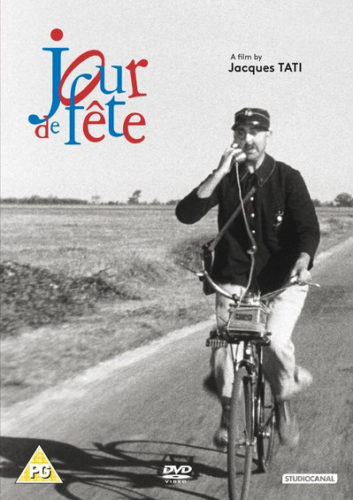
Jour de Fête
Synopsis
In a small French town, the local postman, scatterbrained and bumbling François (Jacques Tati), spends his working hours casually delivering the mail, while being the subject of the townsfolk's teasing. When a traveling carnival arrives in town, a drunken François is goaded into watching a film depicting the efficiency of the U.S. Postal Service. Inspired by the footage, the hapless François sets out on his bicycle to become just like the mail carriers in the United States.
Technical Innovations
Jour de Fête represents several important innovations in Tati's career and French cinema:
- Color Experimentation: Tati originally shot the film in both black and white and with an experimental color process called Thomson-Color, though technical limitations meant it was initially released only in black and white.
- Location Filming: Unlike many films of its era, Jour de Fête was shot entirely on location in the small village of Sainte-Sévère-sur-Indre, using real villagers as extras.
- Sound Design: While not as elaborate as his later films, Jour de Fête already shows Tati's interest in using sound for comedic effect, with selective amplification of everyday noises.
- Visual Storytelling: The film establishes Tati's preference for visual comedy over dialogue, with many gags relying entirely on physical action and careful composition.
Critical Reception & Legacy
Jour de Fête was a commercial and critical success upon its release, establishing Tati as a major filmmaking talent. It won the Grand Prix du Cinéma Français and the Prix de la Critique Internationale at the 1949 Venice Film Festival.
The film's color version was thought lost for decades, but in the 1990s, Tati's daughter Sophie Tatischeff oversaw a restoration that finally allowed audiences to see the film partially in its intended color form, and later a full color version was created using modern digital techniques.
Today, the film is celebrated for its warm humor, meticulous observations of rural French life, and as the first major showcase for Tati's unique comedic vision. Its influence can be seen in filmmakers who use physical comedy and visual storytelling to comment gently on social changes.